

Gingerbread Men: Traditional Recipe for a Delicious Christmas or New Year’s Eve | Bona Sanitas

Gingerbread Men: Traditional Recipe for a Delicious Christmas
There is something irresistible about a well-made gingerbread man. The warm fragrance of cinnamon, ginger, and molasses that fills the kitchen as they bake. The satisfying snap when you break one in half. The white icing smile that someone — a child, most likely — drew with complete concentration and absolute pride. Gingerbread men are one of those baking traditions that manages to be simultaneously ancient and effortlessly contemporary, familiar to almost every culture that celebrates winter festivals and immediately legible as a symbol of hospitality, joy, and the season.
This recipe is part of our healthy recipes collection and delivers gingerbread men that are perfectly spiced, slightly crisp at the edges with a tender, chewy center — the exact balance that distinguishes a truly well-made gingerbread man from the cardboard-dry version that gives the category an undeserved bad reputation. The recipe makes approximately 24 cookies depending on the size of your cutter, and the dough can be made well in advance, frozen, and baked fresh whenever needed.
Whether you are baking them to decorate the tree, to give as gifts wrapped in cellophane with a ribbon, to make with children who will claim the best-looking ones for themselves, or simply because the house smells extraordinary when they are in the oven, this guide covers everything: history, ingredients, detailed four-phase preparation, decoration techniques, storage, and creative variations.

History: Gingerbread Men Through the Centuries
The gingerbread man as a distinct form — a human-shaped biscuit — has a history that stretches back at least to the sixteenth century, though spiced gingerbread itself is considerably older. Ginger and other warm spices were precious, expensive commodities in medieval Europe, transported along the same trade routes that brought silk and other luxury goods from Asia. Their use in food was associated with celebration, prosperity, and the lavishness of important occasions. Gingerbread was not everyday food; it was festive food, and the elaborate forms it was pressed and molded into reflected the craft and care that went into its preparation.
The specific tradition of gingerbread figures shaped like people is often traced to the court of Queen Elizabeth I of England in the sixteenth century. According to popular accounts, the queen had gingerbread biscuits made in the likenesses of visiting dignitaries and honored guests — an edible form of portrait painting that delighted and flattered the recipients. Whether this story is entirely accurate or somewhat embellished, human-shaped gingerbread was certainly a feature of European courts and wealthy households from at least the sixteenth century onward, gradually becoming more democratic as sugar and spices became more accessible over the following centuries.
The gingerbread man’s place in popular culture was cemented by the folk tale of the same name — the story of a freshly baked gingerbread man who springs to life and runs away from everyone who tries to eat him, taunting his pursuers with the famous refrain that he cannot be caught. This story, documented in various forms from the nineteenth century onward across North America and Britain, gave the gingerbread man a personality and a narrative that transformed him from food into character. Today he sits alongside Santa Claus and the Christmas tree as one of the season’s instantly recognizable symbols.
Understanding the Recipe: What Makes Great Gingerbread Men
The difference between excellent gingerbread men and mediocre ones comes down to three factors: the spice balance, the molasses, and the chilling step. Understanding each helps you execute the recipe with confidence rather than guesswork.
The spice blend in this recipe — ginger, cinnamon, cloves, and nutmeg — is a classic combination where each spice plays a distinct role. Ginger provides the characteristic warmth and slight bite. Cinnamon offers sweetness and depth. Cloves contribute an almost medicinal, intensely aromatic quality that anchors the blend and prevents it from tasting flat. Nutmeg adds a subtle, nutty warmth in the background. The proportions favor ginger and cinnamon as the dominant notes, with cloves and nutmeg as supporting players — this produces the familiar, balanced gingerbread flavor that most people recognize and love.
Molasses is the ingredient that separates authentic gingerbread from generic spiced biscuits. It provides the dark color, the bittersweet depth of flavor, and a hygroscopic quality — it attracts and retains moisture — that keeps the finished cookies from drying out too quickly. Dark or full molasses produces the most robust result; light molasses creates a milder, less intensely flavored cookie. If molasses is unavailable, dark treacle is an excellent substitute; golden syrup produces a lighter, less characteristic result.
The chilling step is non-negotiable. The fat in butter is solid when cold and liquid when warm. Cold dough, with solid fat, maintains its structure when cut and transferred to baking sheets, producing gingerbread men with clean, defined edges. Warm dough, with soft fat, loses its shape during handling and spreads during baking, producing soft-edged, misshapen cookies. Two hours minimum; overnight is better.
Ingredients
For approximately 24 gingerbread men (depending on cutter size):
- 360g (3 cups) all-purpose flour, plus extra for dusting
- 1 teaspoon bicarbonate of soda
- ¼ teaspoon fine salt
- 1 tablespoon ground ginger
- 2 teaspoons ground cinnamon
- ½ teaspoon ground cloves
- ¼ teaspoon ground nutmeg
- 115g (½ cup) unsalted butter, at room temperature
- 100g (½ cup, packed) light brown sugar
- 80ml (⅓ cup) dark molasses or black treacle
- 1 large egg, at room temperature
- 1 teaspoon pure vanilla extract
For royal icing (decoration):
- 1 large egg white, at room temperature
- 200g (approximately 1½ cups) icing sugar, sifted
- ½ teaspoon fresh lemon juice
- Food coloring gel or paste (optional — gel produces more vivid colors than liquid)
For decoration (choose according to preference):
- Mini M&Ms or Smarties for buttons and eyes
- Raisins for traditional eyes
- Small round sweets for buttons and features
- Colored pearl sugar and sprinkles
- Edible glitter for a festive sparkle
- Thin ribbon for hanging (thread through holes made before baking)
Preparation: Phase 1 – Making the Dough
Step-by-step instructions:
- Mix dry ingredients: In a large bowl, whisk together the flour, bicarbonate of soda, salt, ginger, cinnamon, cloves, and nutmeg until the spices are thoroughly and evenly distributed through the flour. The fragrance at this stage — before any wet ingredients are added — gives a clear indication of how the finished cookies will smell. Set aside.
- Cream butter and sugar: In a separate large bowl or stand mixer with the paddle attachment, beat the softened butter and brown sugar together at medium speed for 3–4 minutes until the mixture is pale, noticeably lighter in color, and fluffy. This creaming step incorporates air into the fat and sugar, which contributes to a more tender finished cookie.
- Add wet ingredients: Add the molasses, egg, and vanilla extract to the creamed butter mixture. Beat at medium speed until everything is fully incorporated and homogeneous. The mixture may look slightly split or curdled — this is normal and will resolve when the flour is added.
- Incorporate dry ingredients: Add the flour mixture in two or three additions, mixing on low speed (or folding gently by hand with a spatula) between each addition. Stop mixing the moment the dough comes together and no dry flour remains visible. Over-mixing at this stage develops gluten excessively, producing tough, dense cookies that lose their pleasant chewiness.
- Chill the dough: Divide the dough in half and press each portion into a flat disc approximately 2cm thick. Wrap each disc tightly in cling film and refrigerate for a minimum of 2 hours. Overnight refrigeration produces better flavor development and makes the dough significantly easier to handle. Do not skip this step.
Total time for Phase 1: 20 minutes + minimum 2 hours chilling
Preparation: Phase 2 – Rolling, Cutting, and Baking
- Preheat and prepare: Heat the oven to 175°C (350°F / Gas Mark 4). Line two or three baking trays with parchment paper or silicone baking mats.
- Temper the dough: Remove one disc from the refrigerator and allow it to rest at room temperature for 5–10 minutes if it feels very firm. It should be cold and firm but yielding enough to roll without cracking. If at any point during working the dough becomes warm and sticky, return it to the refrigerator for 10–15 minutes before continuing.
- Roll the dough: On a lightly floured surface — or between two sheets of parchment paper to minimize added flour — roll the dough to a consistent thickness of approximately 5–6mm. Thinner than 5mm and the cookies become fragile and crisp through; thicker than 7mm and they take longer to bake and have a less satisfying texture. Using spacers (rubber bands around the rolling pin, or purpose-made thickness guides) ensures perfectly even thickness across the entire sheet.
- Cut gingerbread men: Press the gingerbread man cutter firmly into the rolled dough and cut as efficiently as possible, leaving as little wasted dough between cuts as you can manage. Gather the offcuts, press gently back into a ball, re-roll, and continue cutting until the disc is fully used. The second and subsequent rolls produce cookies that are very slightly tougher due to additional gluten development, but the difference is small and practically unnoticeable in the finished cookies.
- Add hanging holes (optional): If you intend to hang the gingerbread men on a Christmas tree or use them as gift tags, use a drinking straw or thin skewer to press a small hole through the top of each unbaked cookie, approximately 1cm from the top edge. Make the hole slightly larger than you want it in the finished cookie — it will close somewhat during baking.
- Transfer and pre-chill: Using a thin, flat spatula, carefully transfer the cut cookies to the prepared baking trays, spacing them approximately 4–5cm apart. For the sharpest edges and best retention of shape during baking, slide the trays into the freezer for 10–15 minutes before baking. This firms the butter in the dough one final time and prevents spreading.
- Bake: Bake for 10–12 minutes until the edges are lightly golden and firm to the touch. The centers should still feel slightly soft and underdone — they will firm as they cool. Bake one tray at a time on the center rack of the oven for the most even result. Rotate the tray 180 degrees halfway through if your oven has hot spots. Watch carefully in the final two minutes: the difference between perfectly baked and slightly overbaked gingerbread men is measured in seconds, and overbaked cookies become hard and dry.
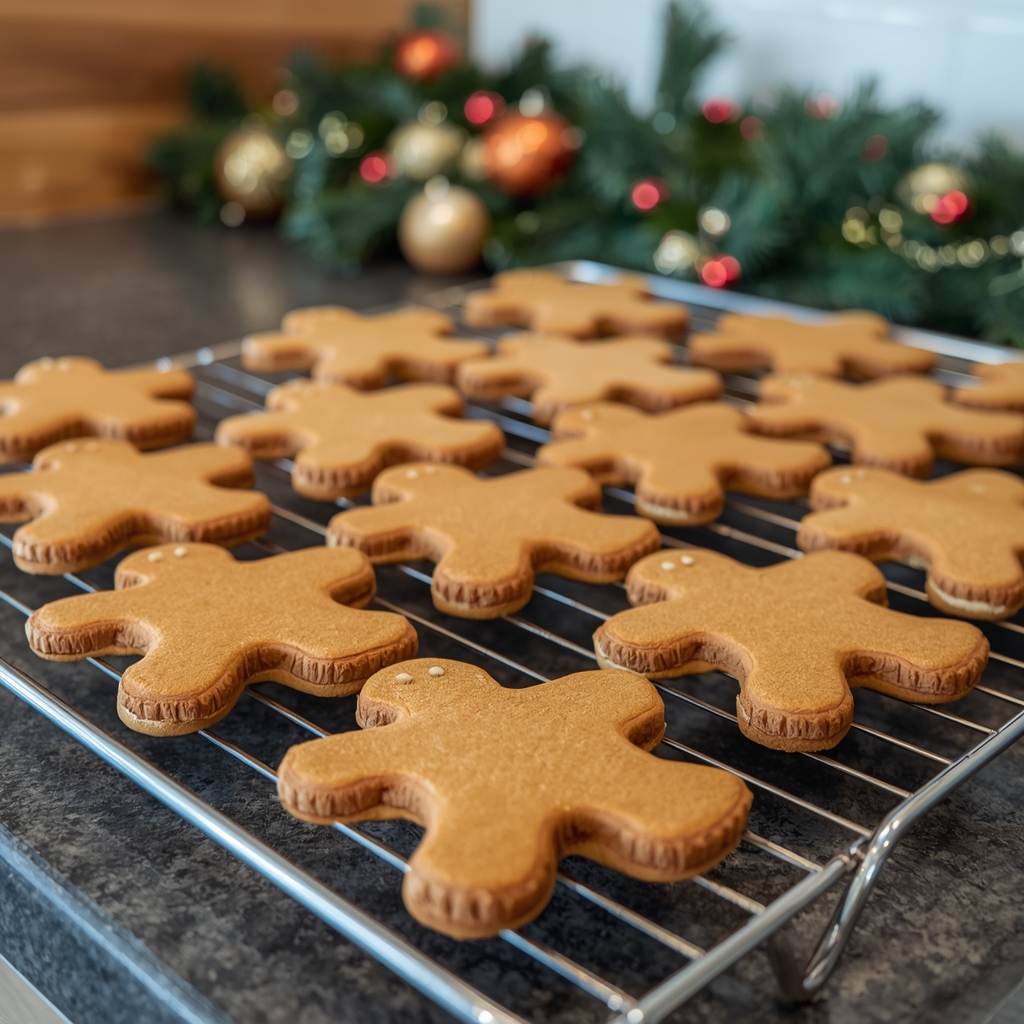
- Cool completely: Allow the cookies to rest on the baking tray for 5 minutes before transferring carefully to a wire rack. Cool completely — at least 30 minutes — before beginning decoration. Decorating warm cookies will cause the royal icing to melt and slide, and partially melted icing cannot be fully recovered.
Total time for Phase 2: 45 minutes
Preparation: Phase 3 – Royal Icing
- Prepare equipment: Ensure the bowl and whisk are completely free of grease — even a trace of fat prevents egg whites from whipping properly. Wipe both with a paper towel dampened with a little white vinegar if you are in any doubt.
- Begin beating: Combine the egg white and lemon juice in the clean bowl. Beat at medium speed for about 1 minute until the mixture is slightly frothy — not to soft peaks, just lightly aerated.
- Add icing sugar: Add the sifted icing sugar in two or three additions, beating at low speed between additions to avoid creating a sugar cloud. Once all the sugar is incorporated, increase the speed to high and beat for 3–5 minutes until the icing is thick, smooth, and glossy.
- Test and adjust consistency: For drawing outlines, writing names, and creating buttons or decorative details, the icing should be thick enough to hold a clean line without spreading — it should form a peak that holds upright when the whisk is lifted. For flooding (filling areas with color), thin the icing gradually with water drops at a time until a line drawn through the surface disappears in about 10 seconds.
- Color the icing (optional): Divide the icing into small bowls according to how many colors you want. Add food coloring gel paste one toothpick-tip at a time, mixing thoroughly after each addition. Gel paste produces more vivid, stable colors than liquid food coloring and requires far less quantity to achieve the same intensity.
- Transfer to piping bags: Fill piping bags fitted with small round tips, or use zip-lock bags with one bottom corner snipped to create a small opening. Close all bags tightly and cover any remaining icing in bowls with a damp cloth pressed directly onto the surface. Royal icing forms a dry crust within minutes when exposed to air.
Total time for Phase 3: 15 minutes
Preparation: Phase 4 – Decoration
- Classic gingerbread man decoration: The traditional decoration is deceptively simple and surprisingly expressive. Two dots of white icing (or two raisins or small sweets pressed into the unbaked dough before baking) for eyes. A curved line of white icing for the smile. Three dots or small sweets for buttons down the front. A bow tie drawn at the neck with a small figure-eight of icing. This minimal decoration allows the warm brown color of the gingerbread to do most of the visual work, and the contrast of white icing against dark cookie is both classic and beautiful.
- Outline first, then flood: For more elaborately decorated cookies with solid areas of color, use the two-stage flooding technique. First, pipe a thin outline using thick icing around the area you want to fill — jacket lapels, trousers, a hat, a scarf. Allow this outline to set for 5–10 minutes. Then fill the interior with thinner, more liquid icing of the chosen color, spreading with a toothpick to reach into corners and eliminate any air bubbles. Allow to dry fully (several hours) before adding any additional details over the flooded surface.
- Creative characters: The gingerbread man template is endlessly adaptable to different characters. A Santa Claus requires red coat and hat flooding, white beard and pompom details, a black belt, and black boots. An elf needs green jacket and hat, a pointy collar, and curled shoes. An angel uses all white flooding with gold or yellow halo and wing details. Each member of a family can be given a unique color scheme and decorative details that represent them — this is particularly engaging for children who can decorate their own version of themselves.
- Add sweets and decorations: Sweets and other three-dimensional decorations should be pressed into wet icing before it sets — not glued onto dry icing, which creates an unstable bond. Position sweets within the first few minutes of applying icing in the area where they will sit.
- Final drying: Allow decorated cookies to dry completely for a minimum of 2–4 hours at room temperature before stacking, packaging, or hanging. The icing must be completely hard and dry to the touch. Rushing this step causes smudging, sticking, and icing transfer when cookies are handled.
Total time for Phase 4: 30 minutes active + 2–4 hours drying
Professional Tips for Perfect Results
Measure carefully. Gingerbread dough is less forgiving of imprecise measurements than some baked goods. Too much flour produces dry, crumbly cookies; too little and they spread too much during baking. Use a kitchen scale rather than volume measurements where possible — the difference between a loosely and a firmly packed cup of flour can be as much as 30% by weight.
Cold dough is always better dough. Every time the dough warms during handling — from the heat of your hands, from working at a warm room temperature — the fat softens and the cookies become more likely to spread. Keep the disc you are not currently working with in the refrigerator, and if at any point the dough becomes difficult to handle, chill it for 10–15 minutes before continuing.
Resist overbaking. Gingerbread men that look underdone when they come out of the oven will firm up perfectly as they cool. Gingerbread men that look perfectly done when they come out of the oven will be too hard when they cool. The difference between slightly underbaked and perfectly baked, measured at the moment of removal from the oven, is a few seconds and a subtle change in the appearance of the center. Trust the process and pull them early.
Royal icing is unforgiving of grease. If your icing fails to thicken properly despite extended beating — remaining liquid and flowing even after several minutes — the cause is almost certainly a trace of fat in the bowl or on the whisk. Start again with clean equipment. This is the most common source of royal icing failure and has nothing to do with the recipe.
Involving the Whole Family
Gingerbread man baking is one of the most genuinely inclusive kitchen activities available to families with children of different ages. Every age group has something real to contribute, and the decoration phase in particular produces a table of creative work that everyone is proud of.
Children ages three to six can help add dry ingredients to the bowl, use cookie cutters to press shapes into the rolled dough (with the adult handling the rolling), and decorate with pre-placed sweets and a shaker of pearl sugar. The physical satisfaction of pressing a cutter into dough and seeing a gingerbread man emerge is something that never quite loses its appeal regardless of age. Children ages seven to twelve can measure and weigh ingredients, roll the dough with guidance, use piping bags for icing (starting with thick outlines before attempting flooding), and create original character designs with full creative ownership of their cookies.
For large family sessions, set out the decoration supplies in individual stations so each person has their own work area and their own set of icing colors. This prevents the bottleneck of everyone reaching for the same bag of icing and makes the finished cookies more varied and interesting as a collection.

Storage, Gifting, and Creative Variations
Undecorated gingerbread men keep very well. In an airtight container at room temperature, they remain fresh and pleasantly chewy for up to two weeks. They freeze excellently for up to three months — lay them flat on a tray to freeze individually before transferring to a freezer bag, which prevents them from sticking together. Decorated cookies should be stored in an airtight container with layers separated by parchment paper, at room temperature for up to one week. A slice of fresh bread placed in the container helps maintain moisture and keeps the cookies from drying out — replace the bread every two days.
As gifts, gingerbread men are among the most charming and personal homemade presents available. Individual cookies can be wrapped in small cellophane bags tied with a ribbon and labeled with the recipient’s name — particularly effective when the cookie itself is decorated as a miniature representation of the recipient. A set of six mixed characters arranged in a decorative box lined with tissue paper makes a beautifully presented seasonal gift. Cookies with hanging holes can be given as tree decorations, though the recipient should understand they will need to be consumed before they become stale.
The basic recipe is a reliable platform for flavor variations. Chocolate gingerbread adds 3 tablespoons of sifted cocoa powder to the dry ingredients, producing a darker, more complex cookie with a pronounced chocolate note that pairs particularly well with plain white icing. An orange and ginger variation adds 1 tablespoon of freshly grated orange zest to the wet ingredients, creating a brighter, more citrus-forward profile. A chai-spiced version adds ½ teaspoon of ground cardamom and a pinch of black pepper to the existing spice blend for a more aromatic, complex result. Replacing half the molasses with pure maple syrup creates a lighter, more subtly sweet cookie with a distinctive maple note.
For the dough shape, the gingerbread man cutter is just one of many possibilities. Christmas trees, stars, snowflakes, bells, and reindeer all work with exactly the same recipe. Alphabet letters cut from the same dough can spell messages or names when arranged together. Animals — cats, dogs, rabbits, horses — transform a batch of gingerbread men into a gingerbread menagerie. Browse our collection of wellness recipes for more seasonal baking ideas, and explore our complete recipes archive for year-round inspiration. For festive gifts and romantic occasions, our romantic cuisine collection offers more ideas for edible expressions of celebration and care.
You can also read Tales from the archives: « The Gingerbread Man » (Mayo Clinic).